
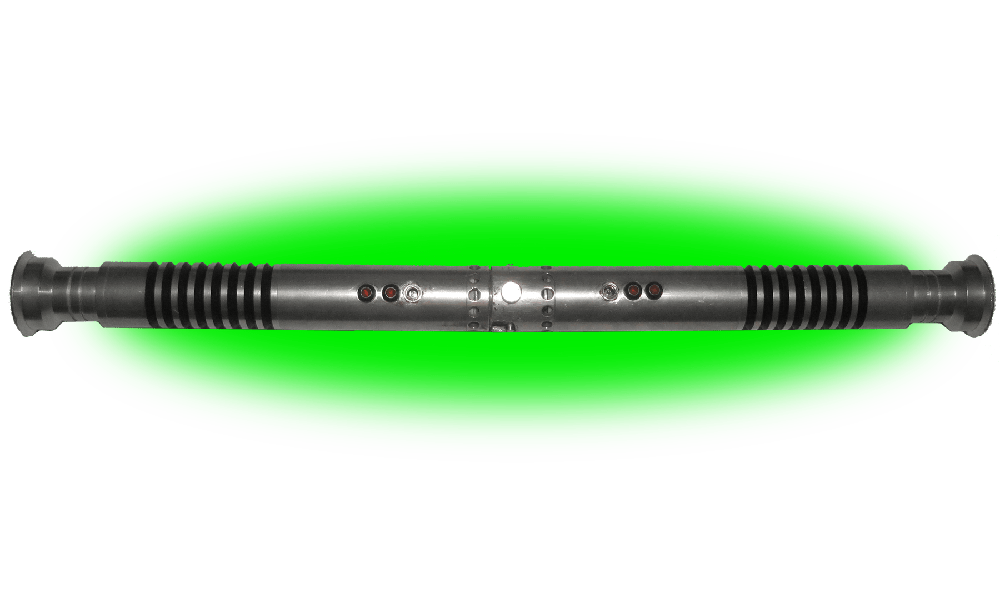
The Amphibolia (Latin for “ambiguity”) is Markus’ first self-built lightsaber.
The hilt is made of parts from the Modular Hilt System (MHS) by The Custom Saber Shop. Parts of this modular system were used for the team’s lightsabers for many years.
Designed as a training and show saber, the design is kept simple: the thin blade holder with extra-beveled edges compared to the regular model provides an ideal grip without sharp edges. There are no protruding elements either that would sit uncomfortably in the hand. The saber is designed as a double-bladed lightsaber. The bayonet coupler was made by JQSabers, so the saber can be split and put back together in one move.
Specifications:
- MHS hilt parts
- matte black powder coating
- Crystal Focus Saber Core 4.0 by Plecter Labs
- 3.7 V 18650 lithium-ion battery
- Seoul P4 LED
- 1 W speaker
- Saberproject-style LED switch
- 2.1 mm recharge port
- JQsabers coupler


The Lightsaber in Shows and at Events
Completed for Jedi Con 2010, it was then used in shows until the end of 2012, including at the Fantasydays, Movie Park, Legoland and the Technik Museum Speyer, before being replaced by the Vortex in 2013.


Building the Lightsaber
Unlike today, when every part for building a lightsaber is easy to get, sourcing the soundboard in particular was not easy back then. The installed soundboard, the then-revolutionary Crystal Focus Saber Core 4.0 by Plecter Labs, was sold in quantities of at most 150 units per year, worldwide. Good connections to Erv of Plecter Labs made buying it a lot easier.
Without 3D printing, which was still a long way off at the time, the entire chassis was cut, sanded and glued by hand from a PVC pipe and a plastic profile. Among other things, the grey 32 mm PVC pipe had to be sanded down evenly along its entire length to fit into the MHS parts (inner diameter 31.75 mm), a huge amount of work and a huge mess.
Today an established mechanism worldwide, the way the switches work was an innovation back then: the shortened LED holders glued into the hilt contain the head of a 5 mm LED. This presses the switches glued into the chassis. The advantage is that the chassis can simply be pulled out of the hilt for maintenance without having to unsolder any switch wires.
The first iteration used a 4.8 V NiMH battery pack, which was later replaced by a 3.7 V Li-ion battery.
Since the soundboard in its version 4 at the time didn’t support RGB LEDs yet, only single-color LEDs could be installed. That’s why the saber has several heatsink modules with different colored LEDs that can be swapped quickly via a connector.


YouTube video
One of our early YouTube videos